
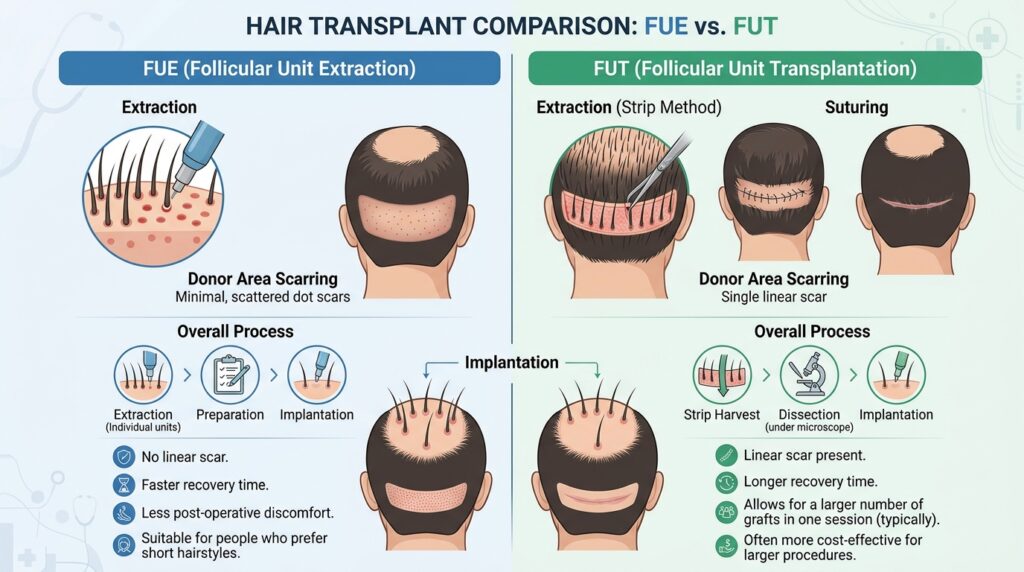
One of the most common questions I encounter in my practice is which hair transplantation technique is better: Follicular Unit Extraction (FUE) or Follicular Unit Transplantation (FUT). The truth is that neither method is universally superior—each has distinct advantages and limitations that make it more suitable for certain patients. This article provides an in-depth comparison to help you make an informed decision.
Understanding the Fundamental Differences
Both FUE and FUT aim to achieve the same goal: relocating healthy hair follicles from donor areas to balding or thinning areas. The critical difference lies in how these follicles are harvested.
FUT (Strip Method)
FUT involves surgically removing a strip of scalp tissue from the donor area, typically measuring 1-1.5 cm in width and varying in length based on the number of grafts needed. This strip is then divided into individual follicular units under stereoscopic microscopes. The donor site is closed with sutures, leaving a linear scar that is usually concealed by surrounding hair.
The procedure has been refined significantly since its introduction in the 1990s. Modern closure techniques, including trichophytic closures where the edges are beveled to allow hair to grow through the scar, have greatly improved cosmetic outcomes.
FUE (Individual Extraction)
FUE extracts individual follicular units directly from the scalp using small circular punches. These punches, typically 0.8-1.0 mm in diameter, remove each graft with its surrounding tissue. The extraction sites heal as small circular scars that are generally imperceptible, even with very short hairstyles.
The technique requires the donor area to be shaved (though partial shaving techniques exist), and each follicle must be extracted at the correct angle to avoid transection. Advanced FUE utilizes powered devices and robotic assistance to improve speed and precision.
Detailed Comparison: Advantages and Disadvantages
Scarring and Cosmetic Appearance
This is often the deciding factor for many patients. FUT leaves a linear scar in the donor area. With proper surgical technique and good healing, this scar can be quite thin (1-2 mm) and easily concealed by hair as short as 1-2 cm. However, factors such as scalp tension, healing characteristics, and surgical technique can affect the scar width.
FUE leaves multiple tiny circular scars scattered throughout the donor area. These are typically 0.8-1.0 mm in diameter and, when properly performed, are virtually undetectable even with buzz cuts. This makes FUE ideal for patients who prefer to wear very short hairstyles or have concerns about linear scarring.
However, it’s worth noting that overharvesting with FUE can create a moth-eaten appearance in the donor area, as the cumulative effect of hundreds or thousands of small scars can become noticeable. Proper distribution of extraction sites is essential.
Graft Yield and Quality
FUT generally allows for higher graft yields in a single session. I routinely perform FUT procedures harvesting 3,000-4,000 grafts, and in some cases, even more. This is because we can precisely calculate the number of grafts available from the strip dimensions and follicular density.
With FUE, the number of grafts is somewhat more limited. While large FUE sessions of 3,000+ grafts are possible, they require extensive time and may necessitate harvesting from a broader area. Additionally, there’s a limit to how much can be safely extracted without creating visible thinning in the donor area.
Regarding graft quality, both methods can produce excellent results when performed skillfully. FUT allows for optimal visualization during dissection, potentially reducing transection rates. However, experienced FUE practitioners achieve comparable survival rates. In my experience, graft survival rates are similar between the two methods when performed correctly—typically 90-95%.
Procedure Duration and Cost
FUT is generally more time-efficient. A 2,500-graft FUT procedure typically takes 4-6 hours, while a comparable FUE session may require 6-8 hours or more. This difference arises from the individual extraction of each follicle in FUE versus the bulk harvesting in FUT.
The extended time requirement for FUE translates to higher costs. In most practices, FUE costs 20-40% more than FUT for the same number of grafts. The price difference reflects the increased time, specialized equipment, and technical demands of the procedure.
Recovery and Discomfort
FUE typically offers a more comfortable recovery. There’s no linear incision, so post-operative discomfort is usually minimal. Most FUE patients describe mild soreness that resolves within a few days and can be managed with over-the-counter pain medications.
FUT involves suturing the donor area, which can cause more discomfort during the first week. Patients may feel tightness or tension in the donor area, particularly when turning their head or lying on a pillow. However, this discomfort is manageable and typically subsides within 7-10 days. Sutures are removed after 10-14 days.
Both procedures require similar care of the recipient area, and most patients can return to desk work within 3-5 days regardless of the method used. Strenuous activities should be avoided for 2-3 weeks with either technique.
Donor Area Considerations
Scalp laxity—the looseness or elasticity of the scalp—significantly impacts FUT. Patients with tight scalps may not be good FUT candidates, as excessive tension during closure can widen scars or cause complications. I evaluate scalp laxity during consultation by attempting to pinch the scalp in the donor area.
FUE is less affected by scalp laxity, making it suitable for patients with tight scalps. However, FUE does require sufficient donor density and hair characteristics that allow for clean extraction. Very curly or kinky hair can be challenging with FUE due to the curved follicle path beneath the skin surface.
An important advantage of FUT is preservation of the donor area for future procedures. The linear scar can be excised again if additional procedures are needed, essentially removing the old scar. With FUE, once an area is harvested, those follicles are permanently gone, which can limit options for extensive future restoration.
Clinical Scenarios: Which Method for Which Patient?
FUT May Be Preferable When:
- Those with good scalp laxity who wear their hair longer than 2-3 cm
- Individuals with hair characteristics that make FUE technically challenging, such as very curly hair
- A very thin permanent zone of hair whose yield is insufficient for FUE surgery. however beard grafts have to be extracted by FUE surgery in case of limited scalp grafts.
- FUT is useful if patient is less than 25 yrs of age and has high grade of baldness and needs hair transplant to restore is confidence as maximum hair will come from exclusively permanent zones only. Later he can switch to FUE.
FUE May Be Preferable When:
- Patients prefer to wear very short hairstyles or shave their heads
- Those with tight scalps or concerns about linear scarring
- Patients who have had previous FUT procedures and need additional grafts from scalp and beard.
- Athletes or very active individuals who want to minimize activity restrictions
- Patients willing to invest more for a less invasive approach
Combination Approaches
This strategy offers the benefits of both techniques: high yield initially with FUT, and the flexibility of FUE for subsequent procedures without creating additional linear scars. However with modern tools, there is no difference in yield and later you have to switch to FUE for second surgery. However managing a FUT scar leads to inability to keep short hair in future.
The Role of Technology
Recent technological advances have improved both techniques. Robotic FUE systems use artificial intelligence and precise punch mechanisms to extract follicles with minimal transection. These systems can work for extended periods without fatigue, potentially improving consistency.
For FUT, improved microscope dissection techniques and trichophytic closures have enhanced outcomes. Some practices now use automated graft preparation systems that can separate follicular units more quickly while maintaining quality.
However, technology is only as good as the practitioner using it. The skill, experience, and artistic sensibility of the surgeon remain the most critical factors in achieving excellent results, regardless of the method employed.
Common Misconceptions
Several myths persist about these procedures. One misconception is that FUE is always superior because it’s newer. Both are established, proven techniques.
Another myth is that FUE leaves no scars. While FUE scars are much less noticeable than FUT scars, they do exist. Patients should understand that any extraction method creates some scarring; it’s the visibility of that scarring that differs.
Some believe that FUE is painless compared to FUT. While FUE generally causes less discomfort, both procedures are performed under local anesthesia and involve some degree of post-operative soreness. Neither should be described as completely painless.
Making Your Decision
Choosing between FUE and FUT should be a collaborative decision between you and your surgeon, based on multiple factors including your hair loss pattern and extent, donor area characteristics, hairstyle preferences, budget considerations, and long-term restoration goals.
During consultation, I examine these factors carefully and make recommendations, but the final decision should reflect the patient’s priorities and comfort level. Some patients place the highest value on avoiding a linear scar, making FUE the clear choice.